
Our eCommerce marketing predictions for 2026

When you run an eCommerce store, it’s vital to stay up to date with all the latest marketing and web development trends.
The problem is, when you’ve got an online store to run, it can be hard to stay in the know!
We’ve dug into the data and read the latest reports to predict the top ten digital marketing trends for the twelve months ahead. We’ll also share how you can future-proof your business and use these trends to your advantage.
Article topics
- Being authentic will make you stand out from the crowd
- AI will start to get involved in purchasing decisions
- Brands will be expected to be more entertaining and less transactional
- Follows and likes won’t be as important on social media
- Businesses need to rethink how they appear in the search engines
- Reddit will become an indispensable marketing channel
- Social commerce will become an essential tool for all online stores
- Long-form video content will make a comeback
- AR will return to the forefront
- Collecting first-party data will be essential for all online stores
1. Being authentic will make you stand out from the crowd
Last year saw a flood of low-quality, low-effort AI-generated blog posts, images, and videos across the internet, often referred to as ‘AI slop.’
This type of content is easy and quick to create, but it can leave viewers frustrated and unsatisfied. Over half of people feel uncomfortable on websites that over-rely on AI-generated content.
With many people turning their backs on AI-generated content, taking the time to create genuine and authentic copy and imagery that provides value can make you stand out in 2026.

Interestingly, even AI tools are understanding the importance of good content.
Google recently announced that it is implementing Gemini into Gmail inboxes, using AI to filter out clutter. This makes it more important than ever to create marketing emails that your customers want to read.
How to prepare
Every piece of content you produce, whether it’s a landing page, email marketing campaign, or press release, should have a meaning and purpose behind it. Creating content for the sake of it, to tick boxes, or just to rank in the search engines, is no longer a viable marketing strategy.
In order to know what you want to achieve from your content, you need to understand your target audience. Dig deep into your data to work out who your ideal customer is, and how you can use your content to solve the problems they experience on a day-to-day basis.
Make the most of content generated by other people – this content embraces imperfections and tells a well-rounded story about your business. User-generated content and employee-generated content are great places to start.
2. AI will start to get involved in purchasing decisions
2025 was the year when AI became part of everyday life, with AI Overviews appearing in Google and AI automated tools becoming more prevalent.
AI will become even more prominent in 2026, helping people decide what products and services to buy.

Google unveiled its Universal Commerce Protocol (UCP) at the start of January. This open-source standard, which Google has developed in collaboration with Shopify, will allow AI assistants (like Alexa and Siri) to talk directly to shops and buy items for customers.
Some businesses, like Reebok, are already using UCP in the US., with many other businesses due to come on board soon. Ads for specific products and businesses already appear in AI Overviews (through Performance Max, Google search ads, and Google Shopping), and it’s likely that these will be rolled out to other AI platforms in 2026.
Some users have reported ads being tested in ChatGPT, and while Google hasn’t officially announced it will be adding ads to Gemini, it has spoken privately to some major clients about it.
How to prepare
To make the most of UCP, it’s vital to have an accurate product feed. Most eCommerce platforms now make it easy to make sure your Google Merchant Centre account and the product list on your website are fully synced.
Good structured data (Schema) can also make it easy for UCP to understand your website and recommend the right products to the right people. If you haven’t already added it to your eCommerce site, consider Schema for your product pages.
3. Brands will be expected to be more entertaining and less transactional
The overall aim of your marketing strategy is to increase your eCommerce store’s revenue. It’s highly likely that every social media post, blog article, and email newsletter you create has the same goal – to get people to buy something from your website.
However, the way people consume content is changing. Customers are spending more time online than ever before. The average person spent 7.4 hours a day in 2025 on their mobile phones, computers, and watching television, a 12% increase from 2024.
What does this mean? You need to engage with and entertain your customers – not just sell to them.
Creating engaging content shows customers that you’re human and boosts your reach. The more time people spend viewing and interacting with your content, the more likely you are to appear in other people’s feeds and ‘for you’ pages.
How to prepare
When planning your content strategy, it’s better to target a smaller, more focused group of people than a wider audience. Choose a niche, understand your target customers, and identify what type of content will get their attention.

Every industry can create entertaining content; it’s just a case of finding the right angle. For example, Blendtec showcased its line of powerful blenders in a range of videos on YouTube – blending items like marbles, golf balls, even iPhones!
When publishing content, it’s essential to engage with your customers and build a community – marketing channels like social media are no longer a one-way street. Respond to comments, share customer feedback, and show people that you’re listening to them.
4. Follows and likes won’t be as important on social media
In the past, we’ve all relied on likes and follows to gauge the success of our social media accounts. However, other metrics are now taking precedence.
Now that people are using social media for longer periods of time, passive consumption is becoming valued over active engagement. Social media platforms want to reflect the fact that people are reading and watching your content, even if they’re not liking and commenting on it.
Different social media platforms are starting to prioritise alternative metrics. For example, saves and shares are highly valued on Instagram, as they show that people enjoy your content enough to want to share it with friends, and that they want to bookmark it to read it again later.
On TikTok, re-watches are highly favoured by the algorithm – the more times users come back to your video, the better.
On LinkedIn, saves are important, and the algorithm penalises low completion rates. This means if users don’t make it all the way through your image carousel or document, it can affect your account performance.
Want to know more about getting started on social media? Check out social media marketing for businesses: six steps for success.
How to prepare
The best way to get people to view your content on social media from start to finish? Create good content that’s engaging all the way through, with a strong beginning, middle, and end.

Of course, it’s okay to give your followers a gentle nudge too and encourage them to take action, like this slide on Instagram does.
5. Businesses need to rethink how they appear in the search engines
Is SEO dead? It’s not, but it’s changed a lot in 2025!

AI platforms like ChatGPT and AI Overviews in Google have changed the way people search and consume information online. AI Overviews (like the one shown above) have contributed to 58% of Google searches now resulting in zero clicks.
This means people are grabbing the information they need in AI Overviews, without visiting websites.
As a result, businesses now either have to get cited in AI platforms or AI overviews (a new practice referred to as generative engine optimisation, or GEO) or create content so good, it stands out from the AI-generated results.
How to prepare
The good news is that queries with transactional search intent aren’t affected by AI Overview in the same way that queries with informational, commercial, or navigational search intent are.
However, this may change in the future, so it’s important to stay two steps ahead.
Here are some of the ways you can increase the chances of appearing in AI-generated answers:
- Showcase your experience, authority, and expertise. AI-generated results only want to link to the most trustworthy content
- Aim to rank as high as possible in the search engines – if you’re number one in the rankings, you’ve got a 33% chance of being cited in the relevant AI Overview
- Create one-of-a-kind content that other businesses don’t (or can’t) offer
- Try to rank for longer, more conversational keywords – people use these on AI platforms to provide more context and receive a more detailed response

Many SEO tracking platforms now offer tools you can use to see which AI platforms your business is cited on and for which terms – we predict these will become a must in 2026.
6. Reddit will become an indispensable marketing channel

Reddit has skyrocketed in popularity over the past few years, to the point where it has overtaken TikTok as Britain’s fourth-most visited social media platform.
What’s made this discussion platform so popular? It offers communities for every interest, no matter how small, and its upvote system makes it easy for people to uncover the most popular and trusted content.
Reddit isn’t just popular with people; it’s popular with the search engines too. Reddit partnered with Google in a content licensing deal in 2024, allowing Google to train its AI on it. As a result, Reddit content typically ends up ranking on the first page of the search results.
The platform is also the number one source for AI answers, beating out platforms like Wikipedia, Quora, and YouTube.
This means that by investing in Reddit, you can boost your presence in the search engine results, as well as influence the AI systems.
How to prepare
Reddit is a slow burn, not a fast solution. If you want to use it to promote your eCommerce store, you need to create an account, sign up for relevant communities, and take the time to comment on relevant posts. Otherwise people may ignore what you have to say.
We’ve put together a guide to using Reddit as an eCommerce business, looking at the benefits and pitfalls.
7. Social commerce will become an essential tool for all online stores

Social commerce, where your customers browse and buy through your social media channels, was big news in 2025, with it accounting for nearly 9% of all eCommerce sales.
With more people browsing social media for longer, social commerce enables you to sell where your customers are. This means if you’re not already using social commerce, 2026 is the perfect year to get started.
How to prepare
If you’re not already using social commerce, we recommend picking one platform you already use and enabling it there. TikTok, Meta (Instagram and Facebook), and Pinterest all offer social commerce.
It’s then a case of uploading a product catalogue to your shop – some eCommerce platforms can automatically sync your online and social media product lists for you.
Next, it’s time to get selling! Remember to do this in a way that provides entertainment and value – show customers how they can become happier, healthier, or more relaxed with your products. Promote the benefits of your products rather than the features.
Social commerce goes hand in hand with influencer and content creator marketing. Work with people who have already bought your products and can provide genuine and authentic insights into how your products have benefited them.
8. Long-form video content will make a comeback

In the past, businesses were encouraged to keep their videos short in order to appeal to shorter attention spans and customers who may be carrying out multiple tasks at once.
This year, we predict that videos will start to become longer. This is tied into a need for businesses to become more entertaining (as we discussed in point three), as well as establish trust.
After all, you have a better chance of demonstrating your worth in a ten-minute video than in a thirty-second one.
Watch time is also a key ranking signal in the YouTube algorithm – the longer people watch your videos, the more likely YouTube is to recommend your videos to them in the future.
How to prepare
Filming and editing a ten, twenty, even thirty-minute video may sound daunting. However, it’s not as challenging as you might think!
You can use long-form videos to walk customers through how to solve a specific problem, showcase your latest seasonal products, or tell the story of your business.
We recommend adding video chapters to any long-form videos you upload to YouTube. This breaks your video into sections, making it easy for people to jump to a relevant part. Video chapters are also picked up in the search engines, helping improve your SEO.
(And don’t forget to caption your video for ease-of-viewing and accessibility!)
While we believe long-form video will dominate in 2026, the right video length for your business will depend on the industry you’re in, what you sell, and your target audience. Try different-length videos, and see which ones your customers respond best to.
Video marketing: how to use it on your website
9. AR will return to the forefront
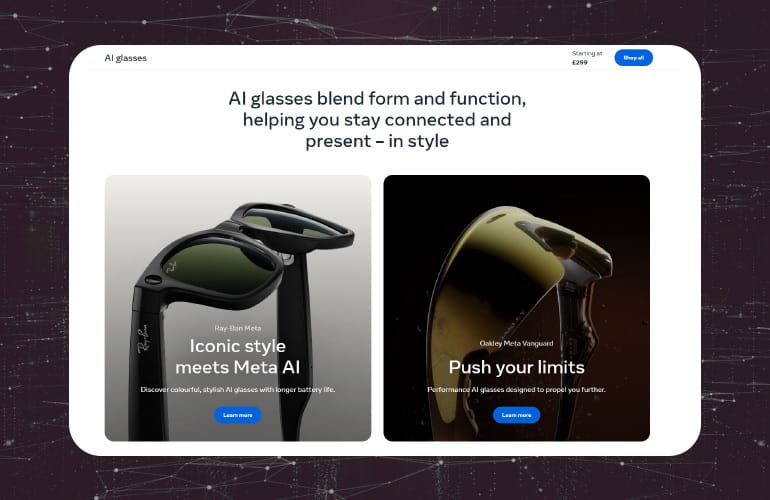
Augmented reality (AR) has operated in peaks and troughs over the past couple of decades. It was popular in the 2010s, then faded away, only to experience a short resurgence when Pokémon Go launched in 2016.
However, with the launch of Meta’s new, advanced range of glasses in September 2025, AR is set to have a revival in 2026.
How to prepare
The key thing to note here is that AR will not be relevant to every type of eCommerce store. While it may be useful for clothing and home decor retailers, it may not be as helpful for food sellers or software providers.
Only go in on AR if it’s something that will provide value to your business, not because it’s on trend!
If you want to take advantage of AR technology, planning ahead is vital. Review your data, convert your assets into 3D, and make sure the tools you create loading quickly and are user-friendly.
The hard work is worth the effort though – 71% of customers say they would shop more often with a business if it used AR.
10. Collecting first-party data will be essential for all online stores

A few years ago, Google Chrome announced it would phase out third-party cookies for all users, in line with other browsers like Firefox and Safari. Following this, there was a rush for businesses to start collecting first-party data – information collected directly through customers, and not through a third party.
However, in 2024, Google Chrome did a U-turn and announced it would not phase third-party cookies out, meaning interest in first-party data subsided.
2026 seems the ideal time to bring first-party data back and own your customer information. Personalisation is more important than ever, and the introduction of ad blockers and app tracking transparency means third-party data is harder to come by than it was.
The EU is also planning to introduce the Digital Omnibus over the next few years, a part of which means people will be able to set their own cookie preferences in their browsers.
How to prepare
The easiest way to collect first-party data is to collect email addresses through your website and other marketing channels.
Show your customers what they have to gain by signing up to your mailing list, whether that’s a discount code or valuable information that will help solve their problems.
Xigen: The eCommerce agency that’s ahead of the rest
2026 is set to be a big year, with the World Cup, Winter Olympics, and Commonwealth Games all taking place. We predict that it will be a massive year for eCommerce businesses too!
If we had to offer one piece of advice for the year ahead – create content that matters.
When you create content that’s authentic, has purpose, and fulfils the needs of your customers, you’re one step close to standing out from all the rest of the noise online.
If you need a little extra help with your online store’s digital marketing and search engine presence in 2026, we’re here to provide the support you need.
Get in touch, and let’s get your business on the right track over the year ahead.


 Back
Back
