
The state of UK eCommerce: 5 lessons from Amazon

Starting as an online bookstore over three decades ago and transforming into a massive eCommerce empire, Amazon is one of technology’s biggest success stories.
It’s estimated that one in ten UK shoppers spends over £170 a month on the platform.
But why do people spend so much money on this online marketplace, and how can you use this information to benefit your own business?
In this series, we’re taking a look at the state of UK eCommerce in 2026, looking at the changes, trends, and news affecting online businesses.
Article topics
- Lesson #1: Start with the customer and work backwards
- Lesson #2: Keep the purchasing process simple
- Lesson #3: Use customer data to your advantage
- Lesson #4: Understand the power of customer reviews
- Lesson #5: Don’t copy what Amazon does
To kick things off, we’re investigating why Amazon has become so successful over the years, and how businesses can apply Amazon principles to their own online stores.
Want to know how to get started selling on Amazon? Check out our comprehensive guide.
Lesson #1: Start with the customer and work backwards
One of the interesting things about Amazon is that it’s constantly growing and evolving as a business, changing to meet customer needs and demands.
The platform started selling just books, expanding into music and videos a few years later. It then launched Amazon Marketplace, where third-party merchants could sell directly to the public.

Today, Amazon doesn’t just offer products, but also livestreaming, smart speakers, e-readers, and even cloud computing.
Amazon’s leadership team follows a set of principles, one of which is called Customer Obsession. While Amazon’s leaders pay attention to competitors, the main focus is on the customer. Every decision is sparked by the question, ‘How can this benefit the customer?’
Amazon gives the example of its cloud computing division, AWS. During the pandemic, it noted that many technology companies would have increased costs to make the most of people working from and staying at home.
However, Amazon looked at how it could help businesses save money and stay afloat during a difficult time.
All eCommerce businesses, regardless of size or industry, can adopt a ‘customer first’ approach to increase customer retention and grow sales.
Ask your customers for feedback, track the customer journey through your website, and understand your customers’ pain points and needs.
Lesson #2: Keep the purchasing process simple

The Amazon website has been designed to make buying, receiving, and returning products as easy as possible, not just on desktop and mobile, but on Kindles and Fire Tablets too!
Amazon launched the 1-Click checkout experience in 1997 – meaning customers could make purchases without re-entering their payment information. Amazon patented it in 1999 to gain an exclusive advantage in the marketplace (although the patent has now expired).
Amazon Prime has also made next-day delivery commonplace, to the point that 78% of customers now expect same-day and next-day delivery as standard across all websites.

The platform has also perfected the seamless returns process. Most returns are free, and the process can be started through its online returns centre.
Even if your business isn’t in a position to offer next-day delivery or free returns, there is still plenty you can do to make buying a product as friction-free as possible. For example, by introducing a guest checkout option to save time.
10 ways to make the checkout process smoother
Lesson #3: Use customer data to your advantage
The average person makes a purchase on Amazon every five days – that means a lot of customer data! Not only this, but the more services you use, including Alexa, Prime Video, and Ring, the more information Amazon can gather.
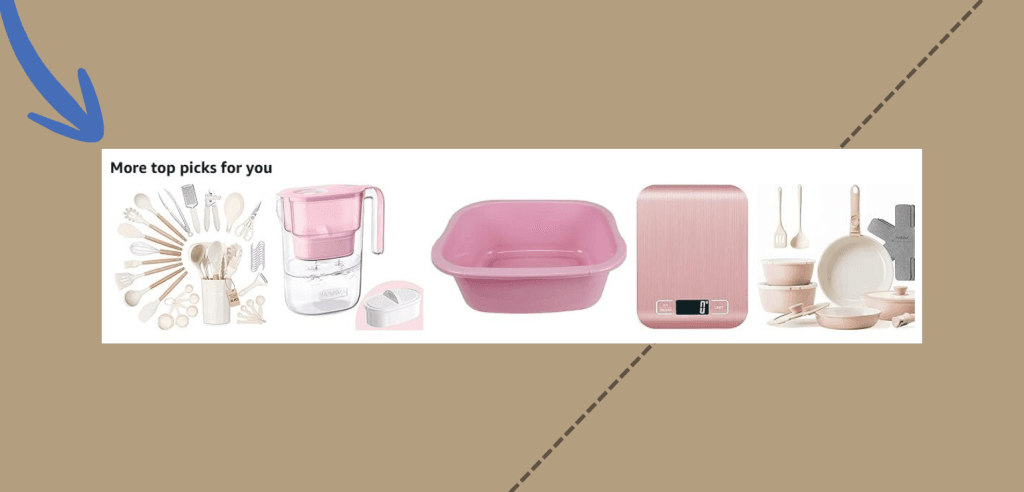
Amazon uses this valuable data to recommend the right products to the right customers, through recommended items on its website, as well as through dynamic display and social media ads.
It’s not just the website that uses this data; the warehouses do too, to predict what customers in a specific area will order. The warehouse teams can then make sure products are available at the nearest fulfilment centre, reducing delivery costs and times.
You’ll gather a lot of customer data through your website, and you can use it to provide a high-quality, personalised experience. For example, through:
- Building email marketing segments
- Creating a personalised homepage
- Personalising search results
- Recommending cross-sells and upsells
(Although of course, make sure all data you collect is securely protected in line with GDPR.)
Lesson #4: Understand the power of customer reviews

Amazon introduced reviews to its store in 1995, encouraging customers to have their say about the items they recently purchased.
As you might expect, online reviews weren’t really a thing thirty years ago. If people wanted to know if a book was good or not, they’d read reviews in magazines or newspapers.
In fact, Amazon’s decision to offer reviews worried publishers, as they were concerned that bad reviews would hurt book sales.
Fast forward to the present day, and over 100 million customers have contributed reviews to Amazon, good and bad.
Not only do reviews help customers decide what to buy, but they’re a positive ranking signal on the platform. A high number of positive, recently submitted reviews can boost a product in the search results.
Even if you don’t sell on Amazon, encouraging customers to leave honest reviews and ratings on either your website or a third-party platform is a good thing. It establishes trust and provides you with valuable information you can use to improve your product offering.
41% of customers say they always read reviews when looking for businesses to buy from, with 47% saying they won’t use a business with fewer than 20 reviews.
Customer feedback – how to use it to grow your business.
Lesson #5: Don’t copy what Amazon does
The Amazon business model is a highly successful one – generating a combined pre-tax profit of £500m in 2024.
However, this doesn’t mean taking Amazon’s business model and applying it to your own eCommerce store will yield the same results.
As a starting point, Amazon typically encourages ‘a race to the bottom,’ where businesses selling the same product lower their prices to compete.
And in a marketplace where Amazon owns the relationship, not you, it’s extremely hard to provide any additional value that may justify a higher price.
If you sell on both Amazon and your own eCommerce website, you may also be dealing with two entirely different target audiences.
The solution? Think about what you offer that Amazon can’t.
For example, while Amazon can offer low prices and fast delivery, it can’t provide deep product expertise or a hyper-personalised service. In an age where nearly 70% of shoppers want personalisation, this is something you can leverage.
Make this the year you transform how you do eCommerce with Xigen
While many people still shop with Amazon, some are turning away from the brand for various reasons. 47% of Gen Z and 40% of millennial shoppers say they are actively trying to spend less on the platform.
This means that by applying Amazon principles to your own online store, you can appeal to shoppers who want an exceptional customer experience and spend their money with a smaller, more ethical business.
If you’re an eCommerce store looking to increase sales, build trust with customers, and showcase your values, we can help.
We’ve been working with well-known and loved eCommerce businesses for over two decades, including Dunelm, Epson, Jackson’s Art Supplies, and Sockshop.
From web design to digital marketing, we’ll make sure your online store is functional, easy to use, and fosters long-term relationships with customers.
Contact us today to get started.


 Back
Back
